The most crowded idea in AI infrastructure right now is also one of the best supported. Power is the constraint. The chips can be ordered, the buildings can be framed and the money, at a price, can be raised, but a data center that can't get electricity is an expensive warehouse. On that point the podcasts, the sell side and the grid operators all agree, and so do we. The more useful question is the one a scarcity always raises next: when something is short, who collects? Over the past twelve months the stock market has given a fairly clear answer, and it runs against the obvious one.
I. The Shortage Is Real
Start with the plainest evidence there is. In July, PJM, the grid operator for 13 states and the District of Columbia, Northern Virginia's data center corridor among them, ran its auction for the capacity it will need in the 2028/2029 delivery year. It procured 138,318 megawatts and still came up 6,831 megawatts short of its own reliability requirement. Only 525 megawatts of the supply that cleared was new generation or uprates of existing plants. The price cleared at $325 per megawatt-day, the ceiling regulators approved for the auction, so the result tells you where the cap sits and very little about what the power is worth.
PJM ran the numbers without that ceiling. The auction would have cleared near $555 per megawatt-day, and the bill would have come to $29.7 billion rather than the $16.4 billion consumers will actually pay. That gap is the scarcity, measured in dollars. It is also, as we will get to, the reason the people who own the power plants haven't been able to keep it.
The equipment side tells the same story from the other end. GE Vernova closed its second quarter with a $176 billion backlog. Its gas power backlog plus the slots customers have paid to reserve on the production line grew from 100 to 116 gigawatts in a single quarter, orders rose 88% organically, and the company expects at least 125 gigawatts under contract by year end. It is expanding turbine output to 20 gigawatts a year this quarter, 24 in 2028 and 30 by 2030, and customers are still queuing for slots years out.
II. The Market Paid the Builders
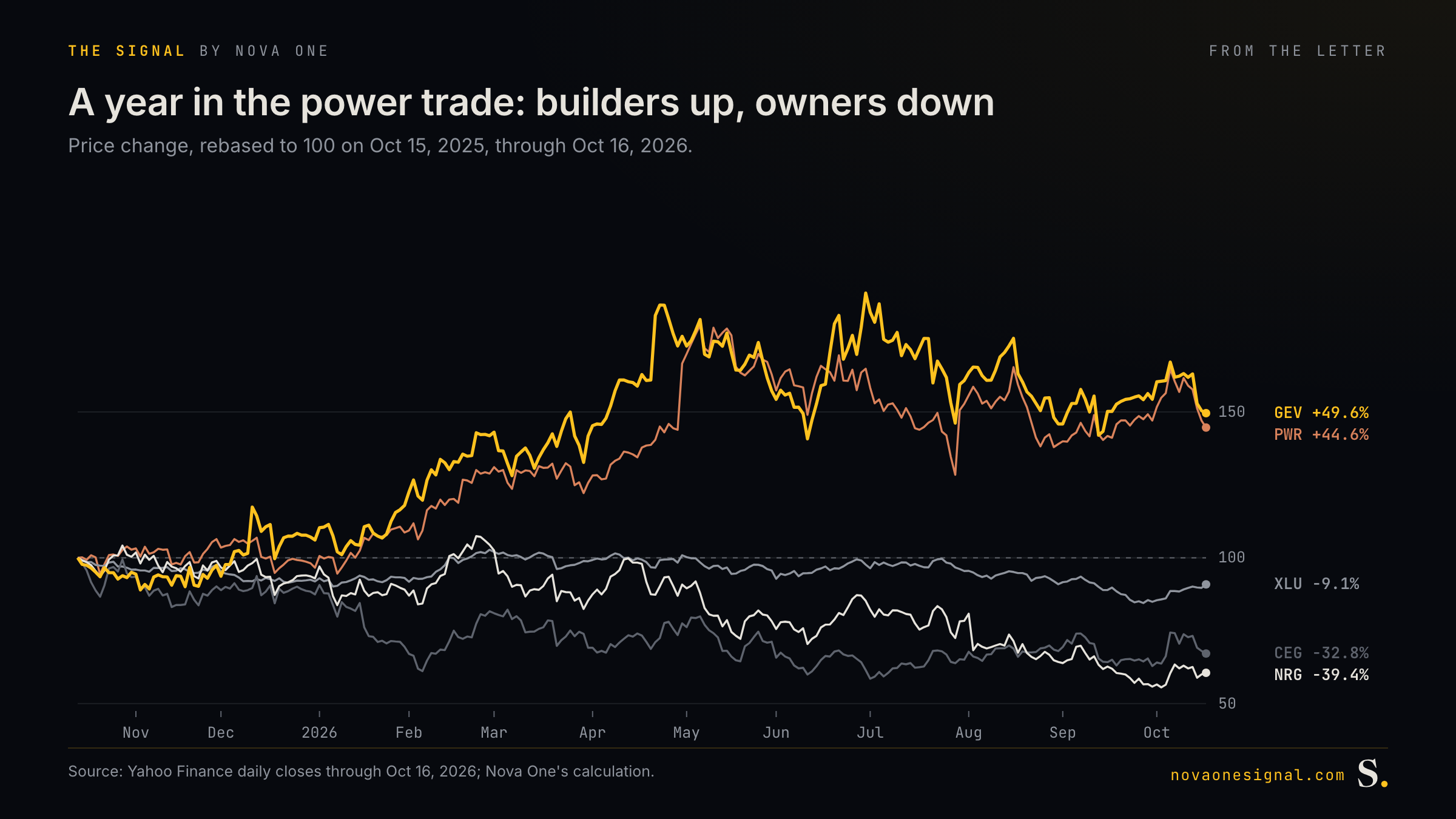
If the scarcity were the whole trade, the owners of existing power plants would be the cleanest way to own it, and for a while they were. From the week ChatGPT launched at the end of November 2022 to last Friday, Constellation is up 182.3% and NRG 144.4%. That was the first chapter.
The second chapter, the last twelve months, looks very different.
| Name | 1 year | 6 months | From 52-week high |
|---|---|---|---|
| Builders: turbines, grid construction, electrical gear | |||
| GE Vernova (GEV) | +49.6% | -8.1% | -21.6% |
| Quanta Services (PWR) | +44.6% | +5.0% | -19.5% |
| Vertiv (VRT) | +14.4% | -32.8% | -45.1% |
| Hubbell (HUBB) | +6.2% | -13.9% | -17.3% |
| Eaton (ETN) | +2.5% | -3.7% | -14.9% |
| Regulated utilities | |||
| Utilities sector ETF (XLU) | -9.1% | -8.6% | -11.6% |
| American Electric Power (AEP) | +7.3% | -4.9% | -8.3% |
| Duke Energy (DUK) | -5.6% | -5.1% | -9.0% |
| NextEra Energy (NEE) | -7.0% | -13.2% | -18.5% |
| Southern Co. (SO) | -8.6% | -3.5% | -8.0% |
| Merchant generators | |||
| Talen Energy (TLN) | -14.7% | -2.9% | -19.0% |
| Constellation Energy (CEG) | -32.8% | -8.4% | -32.4% |
| NRG Energy (NRG) | -39.4% | -38.1% | -43.6% |
| For reference | |||
| S&P 500 (SPY) | +14.7% | +7.5% | -2.0% |
| Semiconductors (SMH) | +57.9% | +16.3% | -19.3% |
Price change through the Oct 16, 2026 close, dividends excluded. Source: Yahoo Finance daily closes; Nova One's calculation.
The two companies that build the most physical capacity, GE Vernova with its turbines and Quanta with the crews that string transmission line and wire substations, rose 49.6% and 44.6%. The regulated utilities, which own the wires and pass costs through to ratepayers, slipped. The merchant generators, the companies that sell power from plants they already own into exactly the markets where it is scarcest, fell hardest, with Constellation down 32.8% and NRG down 39.4%. The utilities sector ETF ended the year 9.1% lower, roughly 24 points behind the S&P 500.
So the market accepted the premise and rejected the obvious trade. It paid the companies that sell the picks and shovels of new supply and marked down the companies that own the supply that already exists.
III. Why the Owners Hit the Ceiling
There is a structural reason for that, and it is visible in the auction result. A shortage of electricity does not show up as a line item on a hyperscaler's income statement. It shows up on household utility bills, and household bills are political. The capacity price that would have cleared near $555 cleared at $325 because a collar was put on it, and that collar exists because a market price for scarce power in an election cycle is a number nobody wants to defend. An owner of existing plants is long the scarcity right up until the scarcity becomes expensive enough for someone to cap it.
The fall brought two more reminders that the owner's payday runs through a hearing room. On Sept. 29 the Federal Energy Regulatory Commission only partly approved PJM's plan for an emergency backstop procurement to cover the shortfall, warning that parts of how the costs would be allocated "may be unjust and unreasonable," and PJM postponed a process that was due to begin the next day, with no new timeline. Four days earlier, PJM's independent market monitor told FERC that 4,016.9 megawatts of forecast data center load had been canceled or delayed as of Sept. 21, which by its count is 42% of the increase in data center load PJM had forecast between the 2026/2027 and 2028/2029 delivery years. When the size of the shortage itself is under dispute, the people paid by the shortage are the ones who absorb the doubt.
The builders sit on the other side of that negotiation. A turbine slot is sold to a buyer who wants it badly enough to pay a deposit years ahead, and nobody holds a hearing about the price. Their revenue depends on someone deciding to build, which a shortage encourages, and not on what the electricity eventually sells for, which a shortage invites regulators to limit. That is the asymmetry the past year has priced. Scarcity is worth the most to whoever sells the remedy, and it is worth less than it looks to whoever owns the scarce thing, because the scarce thing is a public utility in all but name.
There is a second force, and it has been working on every layer at once. The 10-year Treasury yield was 3.99% a year ago and 4.26% in mid-April. It closed Friday at 5.09%. Everything in this table is a long-lived, capital-intensive asset, financed against cash flows that stretch decades out, and that is the kind of asset a higher discount rate hits hardest. It is why the six-month column is red almost from top to bottom, builders included: Vertiv is 45.1% off its high and GE Vernova 21.6%, while semiconductors gained 16.3% over the same six months. The builders won the year. They have not been immune to the cost of money.
IV. What Would Change Our Read
We think the scarcity is real and durable, that the market is right to have paid the builders over the owners, and that the reason is structural rather than a passing mood: a shortage that lands on consumer bills gets capped, and a shortage that lands on an order book does not. Three things would tell us we are wrong.
The first is the ceiling coming off. FERC approved an offer cap of $555 per megawatt-day for PJM's backstop procurement, close to where the July auction would have cleared on its own. If that procurement goes ahead on those terms, or if future auctions are allowed to clear above the collar, the owners will finally be paid at something like the scarcity price, and the bottom of the table should start to close on the top.
The second is the cancellations spreading. The market monitor's count concerns load forecasts, which is the owners' problem. If delayed and canceled data centers begin to show up as canceled turbine slots and smaller order books, the builders' advantage disappears, and GE Vernova's progress toward 125 gigawatts under contract by year end is the cleanest public gauge of it.
The third is the 10-year. Every company in this table would rerate on a sustained decline in long rates. That would lift the whole stack, though in the owners' case it would not remove the cap.
Until one of those turns, we read the past year's verdict as the right one. Everyone agrees power is the moat. The market has worked out that the moat comes with a toll booth, and that the toll is set by regulators.
This document is for informational purposes only and does not constitute investment advice. Nova One Capital makes no representation as to the accuracy or completeness of the information herein, and past performance is not indicative of future results. October 19, 2026.