Pat Gelsinger ran Intel. This week he described the new shape of the chip business in two sentences: "So I can design the thing in three months, but I can't actually get it into real silicon at scale for nine months." His conclusion was blunter: "All of those manufacturing scale issues to me become a huge bottleneck."
That is a builder telling you where the scarcity sits. The design step is getting faster: turn the AI tools loose, he said, and "within three months we have an awesome design." The manufacturing step is not. A chip still has to be etched, layered and inspected, on machines only a handful of companies make.
Here is the odd part. Over the past three months, the market has been selling those companies hard.
I. Who Owns the Slow Step
Four of the largest makers of those machines are Applied Materials, Lam Research, KLA and ASML. If manufacturing is the bottleneck, they sell the equipment the bottleneck is made of. Every new AI chip design, however fast it was drawn, has to pass through their tools.
You would expect that position to be worth more as design speeds up. In the stock market, it has been worth less.
II. What the Market Did
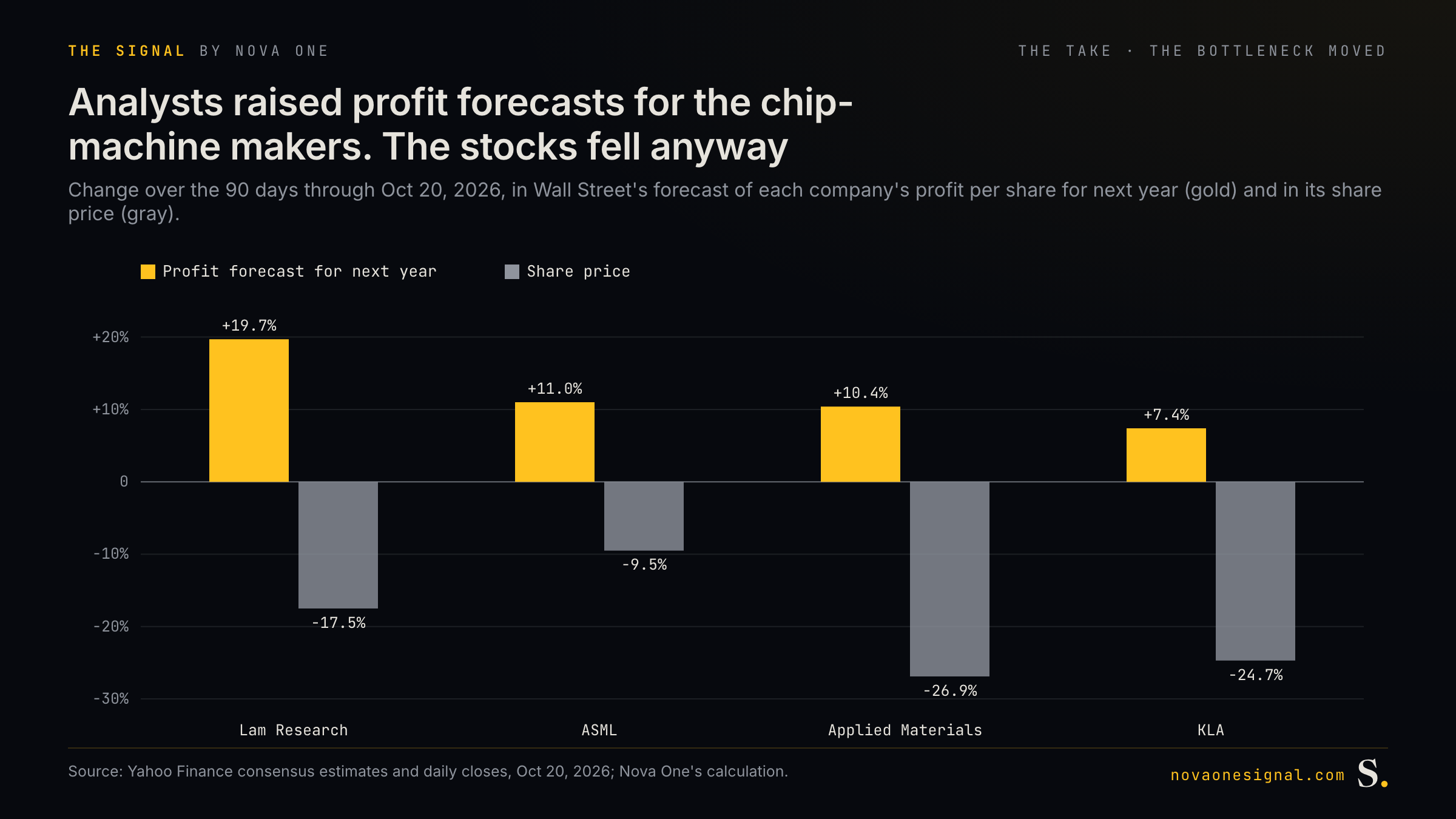
In the 90 days through October 20, the four stocks fell: Applied 26.9%, KLA 24.7%, Lam 17.5% and ASML 9.5%.
Over the same 90 days, the analysts who follow them raised their forecasts for next year's profit: Lam's by 19.7%, ASML's by 11.0%, Applied's by 10.4% and KLA's by 7.4%. In the last 30 days alone, 12 of those analysts raised a forecast and 1 cut one.
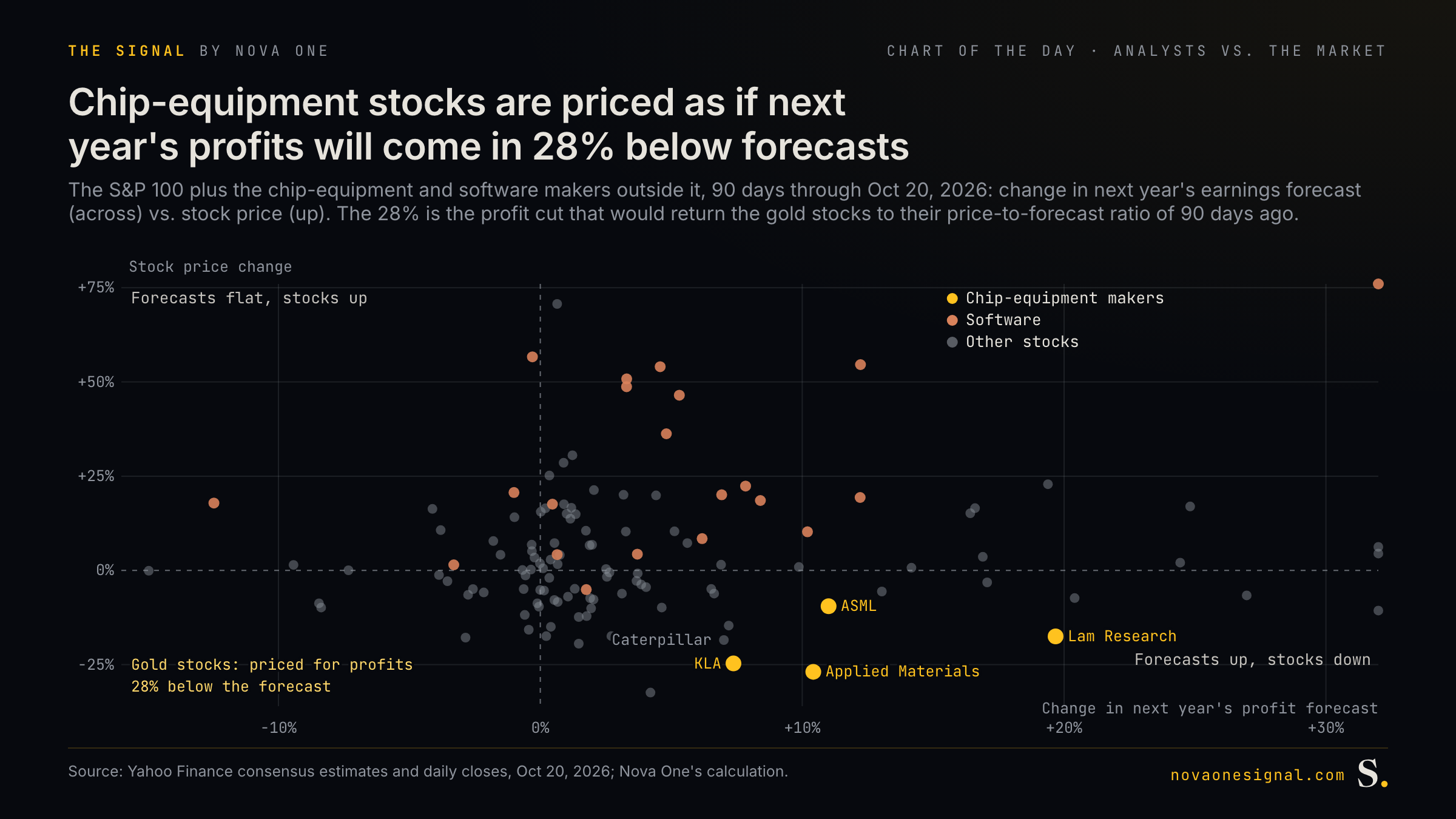
Put the two together. At the price investors were paying for each dollar of expected profit 90 days ago, today's share prices only make sense if next year's profits come in about 28% below what the analysts expect. Either the analysts are about to cut hard, or these stocks got about 28% cheaper per dollar of expected profit since July.
They were not alone. In the week through October 20, the median AI hardware stock lost 11.6% of what investors pay for each dollar of next year's expected profit, while the median big US company gained 1.9%. Profit forecasts for the group moved less than 1%. The market is not reacting to worse numbers. It is paying less for the same ones.
III. The Test Came Wednesday Night
On October 21 we wrote that company guidance would decide which side was right. Lam Research reported that evening.
Lam reported record revenue of $8.22 billion for the September quarter, up from $6.72 billion three months earlier. It earned 40.0% of revenue as operating profit. Then it guided higher: $8.60 billion of revenue for the December quarter, give or take $400 million, with operating margin around 40.5%. Its chief executive, Tim Archer, said the company delivered "record revenue, profit, and earnings per share."
The stock fell about 7% in after-hours trading Wednesday.
Meta reported the same evening. It raised the bottom of its 2026 spending range to $135 billion from $130 billion and said "we expect to continue investing aggressively to support both our core business and emerging AI initiatives."
That is the gap in one evening. A company that owns part of the bottleneck reported a record and raised its outlook, one of its biggest end customers said it will keep spending, and investors paid less for the bottleneck.
IV. The Case for the Market
The selling is not irrational, and there are real reasons to respect it.
Equipment orders are among the most cyclical in technology. Chipmakers buy tools in waves, and equipment stocks have a long habit of falling before the orders do. A record quarter can be the top of a wave as easily as the middle of one.
The scarcity may also pay someone else. If the bottleneck is factory time, the company that owns the factories, not the one that sells the machines, may collect most of the reward. A shortage of finished chips can show up as pricing power for the chipmaker while the toolmaker simply runs at capacity.
And the whole chain rests on one assumption: that Big Tech keeps spending at this pace. Meta has not set a 2027 number yet; it said it is "still developing our budget and capacity plans for next year." Microsoft, Alphabet and Amazon are expected to report next week, and their spending plans for next year are the number every one of these stocks is waiting on.
V. What Would Settle it
If next week's spending plans hold or rise, the companies that make the machines were sold for a slowdown that did not come, and the 28% gap between prices and forecasts has to close from the price side.
If the plans are trimmed, the analysts were late, the stocks were early, and Lam's record quarter will be remembered as the peak.
Gelsinger's point cuts toward the first answer. When designs arrive three times faster than factories can build them, the scarce thing is capacity to manufacture, and capacity is built with these companies' tools. The market is pricing a slowdown. The people building the chips are describing a traffic jam.
We would watch two things: the cloud companies' spending plans next week, and whether the equipment makers' next outlooks keep rising while their stocks do not. A record outlook that the market sells is either the last good news of a cycle or the clearest mispricing in the AI chain. Next week tells us which.
This document is for informational purposes only and does not constitute investment advice. Nova One Capital makes no representation as to the accuracy or completeness of the information herein, and past performance is not indicative of future results. October 21, 2026.